There was a time when professional wrestler and actor Mr. T, also known as B.A. Baracus from the A-Team, fought virtually everything on the internet. The story I am going to tell you today started when I stumbled upon an archived page titled "Mr. T versus The Matrix". In retrospect we can consider the Mr. T comics to be one of the oldest memes according to current definition. First of all, there was not one author. Like modern memes everyone with a spark of creativity could contribute a Mr. T comic. Second, the meme had a distinct format that every contributor adhered to. Third, the comics are full of recurring themes and jokes. Like Mr. T's love for milk (instead of alcohol) and his life long mission of saving youth centers from destruction. There also seem to have been rules, such as that Mr. T. should win the fight in order for it to be considered canon. For a large collection of Mr. T comics, I recommend you to visit this page from the early internet that is still online. Beware that most of the links to the actual comics are now dead. If you toss the links in the Wayback Machine you will be able to read some of them.
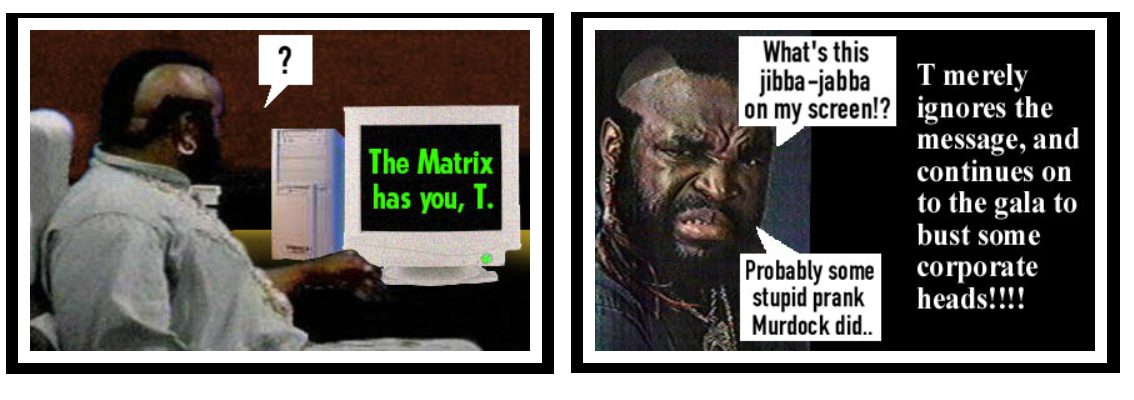
It is hardly a suprise that in 2000 Mr. T fought 'The Matrix' because in 2000 nothing was more hyped than the Wachowskis blockbuster action movie. Although the comic was not archived in its entirety, there is enough there to get the gist of it. When I checked the URL of this page I noticed it was hosted on a site called thematrix.acmecity.com. This webhost, named after the fictional everything company in the Looney Tunes, was entirely new to me, so I went down the rabbit hole to see what it was all about.
In 1999 Geocities was one of the most visited websites on the internet. Its success lead to countless of competitors who wanted a piece of the internet homesteading pie that Geocities had baked. Just from the top of my head, some rivals were Tripod, Angelfire, Xoom and Homestead. In January of 1999 Hollywood film studio Warner Brothers revealed in a press-statement that it would start a joint-ventureship with Fortune City, yet another webhost that was becoming very popular at the time. Founded by the Brits Dan Metcalfe and Richard Jones, it was first marketed as the British counterpart of Geocities. However it quickly gained a significant user base in other European countries. One reason why it was able to grow so quickly was by cleverly playing the search engine algorithms of the time. Another thing that Fortune Ciy did right was localise its offering in every country where it launched. If you visit archived pages of the Dutch, German of French versions of Fortune City you will find the names of neighborhoods you can choose from to be different each time. Read this interesting Guardian interview with Robert Caller, the then European commercial director of Fortune City. Caller claimed that in 2000 Fortune City was the number 11 most visited site on the internet. I do need to clarify that I was unable to confirm this claim. Looking at this page with the 100 most visited websites of 2000, Fortunecity.com is nowhere to be found. Perhaps they were counting hits instead of unique visitors.
This all helps us understand why Warner Brothers saw in Fortune City a strategic partner for making the jump into the internet business. In january 1999 WB bought a 12.5% share in Fortune City. Simultaneously they announced the launch of their webhosting provider ACMEcity.com. ACMEcity was to become a webhosting service for fans of Warner Brothers' intellectual properties. They gave users the opportunity to create a free website with 20mb storage space, focused on their favourite film, tv show or singer. Each area within ACMEcity was based on a specific artist or franchise and would have an appointed "area producer" responsible for viewing and moderating content in order to maintain an advertiser friendly environment.
One of the main motivations for Warner Brothers getting into the webhosting business was intellectual property protection. The arrival of personal websites had people sharing images, music and video files of their favorite shows and movies en masse. Film studios were losing control of their products on a scale never seen before. This often resulted in personal website owners being threatened by Hollywood to either take their content offline or face prosecution. Warner Brothers admits in one of its press statements that it also struggled to deal with the situation, but in a very forward thinking way understood that this was going to be one fight Hollywood could never win. This excerpt from Heather Gold's 1999 article "Building a Web Business on Copyright Infringement" sheds more light on how WB regarded Geocities.
Community sites like Geocities also follow the distributed aggregation model. They create a place online where people with various interests can make their own web sites. These community sites are loaded with infringing content, from photos of celebrities to pirated songs and movies. President of Warner Brothers Online, Jim Moloshok, put out the call to fellow media companies to pay attention to the value they were losing online. As reported in Variety this past March, Moloshok told attendees at Variety’s Interactive Marketing Summit in Rancho Mirage, Calif. that the Web is “being used to build other people’s brands.” Moloshok stated that bootlegged Warner Bros. material represents 4.2 percent of the content in GeoCities’ total community. If Warner Bros. were compensated on a dollar for dollar basis for the unauthorized use of its material it would be worth $147 million,¨Moloshok said. Warner Bros. has no intention of filing suit against GeoCities or its members over the postings, since to do so would mean alienating loyal fans, Moloshok said. Warner Brothers decided that the best route was to join ’em instead of shut them down.
Instead of threatening fans to delete their copyrighted content and risk alienating them, WB started offering fans their own free online webspace designated to a specific fandom. Acmecity was divided into neighborhoods based on a popular TV show, film or artist under the WB label. If for example you created your homepage in 'The Matrix' neighborhood, you would be given access to all kinds of official Matrix related images, gifs, sounds and video clips you could use to decorate your website. To me this all sounds very much not punk rock and at least CNet's Jim Hu shared this sentiment in this 1999 article, where he used ACMEcity to exemplify the gentrification of the internet.
However gentrified, ACMEcity was without a doubt a success. Within four months after launch they had built a userbase of 180.000. In december of 1999 that userbase had increased to 750.000! Certainly ACMEcity was benefiting from the infamous Yahoo Geocities takeover, which happened in january 1999 as well. When Yahoo became the owner of the most popular website on the internet of 1999, they made all their users sign a contract giving Yahoo the rights to use the content on their websites for monetization purposes. Essentially Geocities homesteaders were no longer owners of their own digital homes. Overnight they had became tenants from which value was to be extracted. The Yahoo takeover in hindsight was the beginning of the end for Geocities. It caused an exodus of users looking for a more user friendly alternative. Tripod tried to nudge users into their direction by adding a banner saying "You own your own content". ACMEcity meanwhile saw a 25% increase in new users the first few days after the takeover. They started an ad campaign which read: "Protest! Move Out of Geocities!" to convince more people to move their websites.
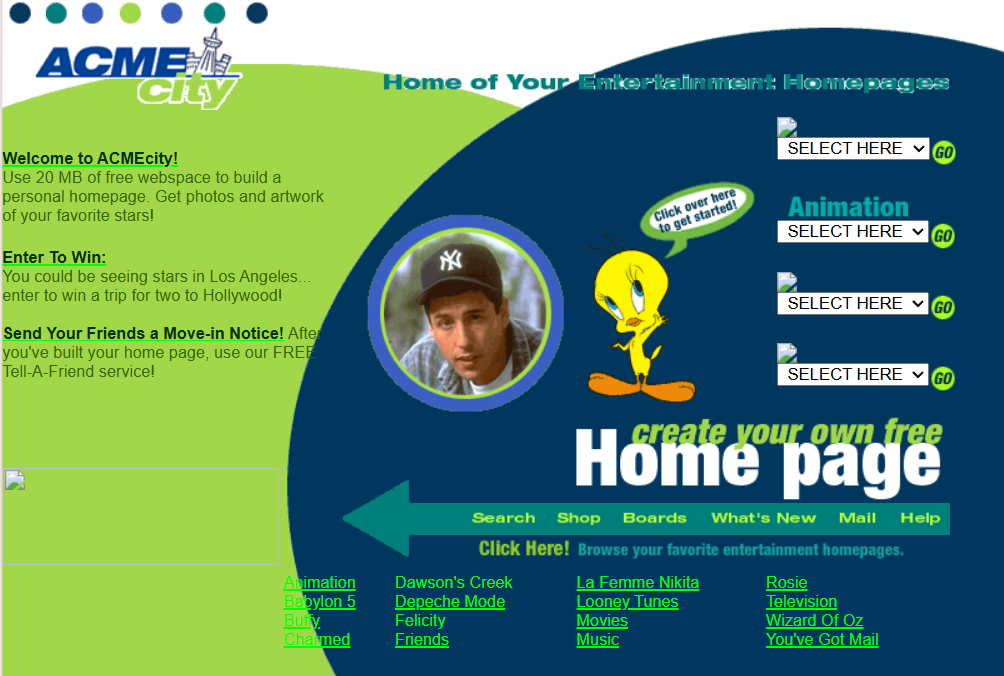
Let's take a look at the ACMEcity homepage in 1999. If you visit the first archived version of the page on january 25th 1999 you will be greeted by Tweety and an Adam Sandler gif welcoming you into town. You were then to choose from a list of neighborhoods to settle down in, such as Babylon 5, Charmed, Friends, Looney Tunes, Depeche Mode and The Wizard of OZ. There was a forum, which was archived for the first time in august '99 and looked to be quite active at the time. A 'What's New' page that simply led you to the WB store and a Help page with some FAQ. There was also a page that ranked the most visited websites on ACMEcity. However, you will notice that even the most popular sites have not been archived very well. One of the best preserved ACMEcity pages I could find was this 7th Heaven fanpage. Fast Forward to November 1999 and the amount of neighborhoods within ACMEcity territory increased significantly. Some notable additions being ER, La Femme Nikita, Pokémon, Missy Elliot, Wild Wild West and of course The Matrix. ACMEcity's popularity also led to some pop culture icons that were not owned by WB like Marvel's Stan Lee and The Muppets to set up shop here.
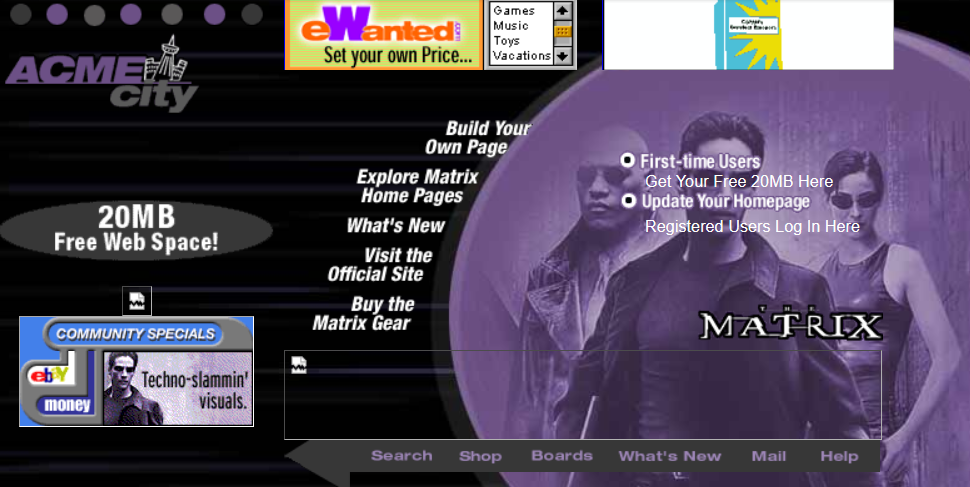
Now let's visit an invidivual neighborhood, like The Matrix. The explore page contained a list of featured links, I expect that they were selected by the neighborhood's so called community leader. If you click here, you will find a page containing information about each neighborhood's community leader. They seem to have been volunteers that users could approach to help them out with any problems arising while webmastering. The Matrix, being one of the more populous towns, had 2 community leaders. Now, as you go exploring the archived webpages of ACMEcity, you will soon notice two things. The first being that most websites have been archived poorly if at all, with almost no image files remaining. The second being that most pages were only archived between 1999 and 2001. How is it possible that a website that generated a lot of media attention and grew to more than a million users within a year, left barely a footnote in internet history? What the hell happened to ACMEcity?
In January 2000, less than a year after the launch of ACMEcity, Internet Service Provider AOL merged with Time Warner Company and became a majority shareholder. AOL bought Time Warner for a staggering 182 billion dollars. It is still the most expensive takeover in history and often regarded as the most disastrous one. The dot-com bubble was about to, but had not yet burst. This explains how an incredibly overvalued AOL was able to persuade shareholders at Time Warner, one of America's biggest media conglomerates, to be purchased. The details and aftermath of this, however interesting, are beyond the scope of today's story, but those interested can read more about it here.
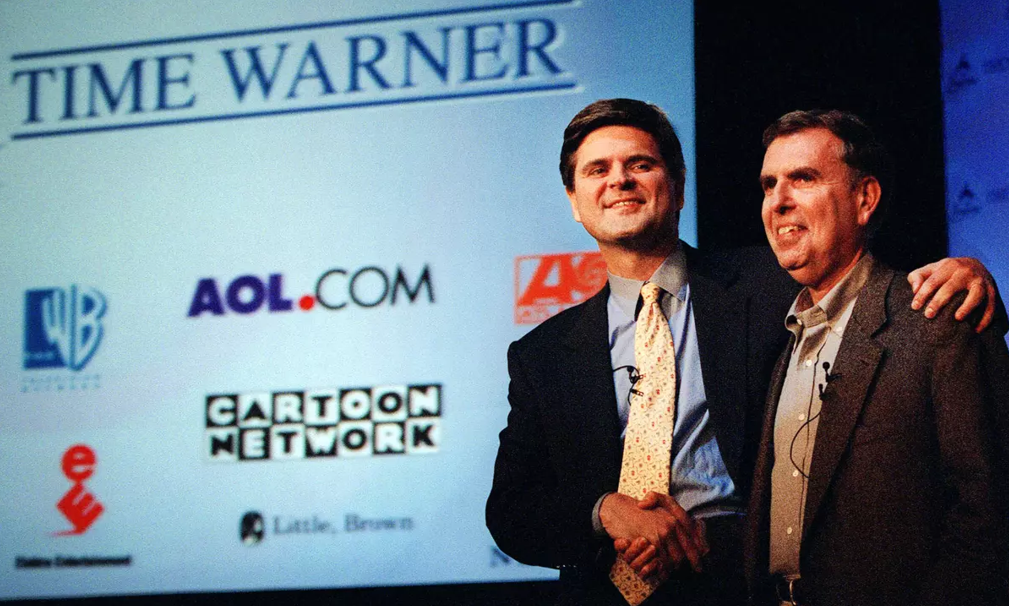
Image courtesy of Stuart Ramson Associated Press
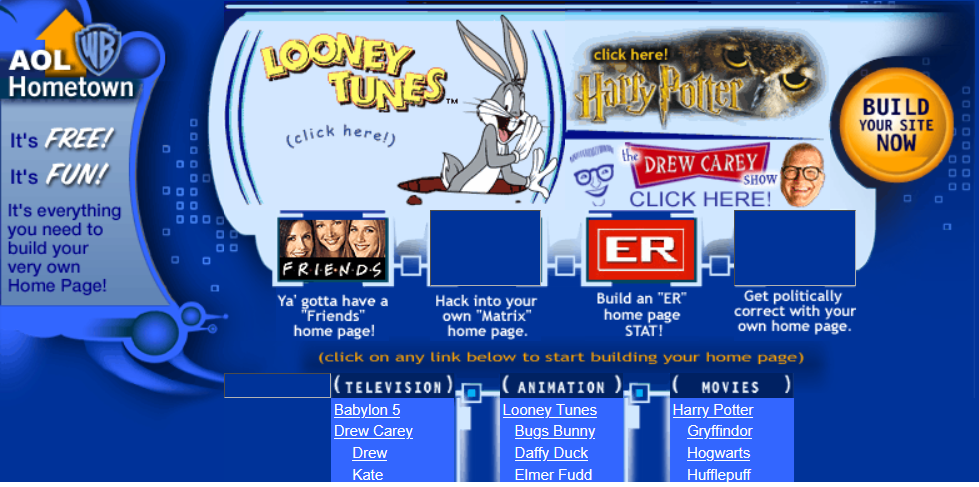
Since AOL already had their own webhosting service under the name of AOL Hometown, it no longer made sense to hold on to ACMEcity. While the rest of 2000 went by rather uneventful, in 2001 it was decided that ACMEcity would cease to exist. The first time we see the shutdown of ACMEcity.com being mentioned on the website is on may 8th 2001 in an official announcement. ACMEcity gave its users the opportunity to move their websites over to AOL Hometown and provided them with the instructions of using an FTP, but at the time when this page was archived there were only 10 days left to do so as the service would be shut down on may 18th. We can not know exactly how much time users had been given to move their data, but the previous archived version of ACMEcity.com on march 2nd makes no mention of the shutdown yet. Therefore in the best case scenario users were given a mere 2 months and 16 days to move their virtual homes! Meaning that if you only checked in to your website on a semi-regular basis, or if you just went on a long vacation, you may have come back to find your website gone forever!
There are some indications that the way the shutdown was handled by AOL Time Warner was received negatively by its users. This forum comment from shortly after shutdown is insightful in that regard. User zz4 mentions that the FTP that was offered to migrate data to AOL's servers was only available if you were an AOL member. The user tried to reach both Time Warner and AOL several times for costumer support, but never got a reply. There were also concerns about the services AOL Hometown would provide. The shutdown announcement does mention that AOL Hometown added 25 new WB related templates that users could choose from when starting a new page, but otherwise there wasn't much information provided. I also found some forum posts where users mentioned they considered moving to rival webhosting providers like Tripod.
If you tried to visit ACMEcity.com after may 16th 2001, you would be redirected to a special frontpage of AOL Hometown designed for former ACMEcity users and be greeted with the recognizable Warner Brothers logo and mascots. Going into it from this side, it seems that the neighborhoods system was still intact at first, but looking at the list there were a lot less franchises to choose from. If you entered AOL hometown from the regular url: hometown.aol.com, there is hardly any mention of ACMEcity. The defunct webhosting service was swiftly being erased from history.
It is clear to me now why ACMEcity was not able to leave its mark on history. Starting out as a way for Warner Brothers to have more control over its intellectual properties online, ACMEcity did have genuine appeal to its users. It enabled them to create fanpages without much knowledge of HTML and with the ease of using the high quality media files WB had made available. It also provided fans the opportunity to easily get in touch with other fans through community functions like the message board. Some people may have disliked ACMEcity for its attempt to gentrify the internet, but its success proved that there was a demand for what it provided. ACMEcity was only around for 2.5 years, which explains why most websites have been archived poorly, if at all. The very short notice given to users before the service shutdown explains why the community did not migrate to AOL Hometown, but rather scattered to other webhosts and mostly just vanished. Also, its shutdown happened too early in the timeline of the internet, before conservation projects like the Archiveteam existed to prevent all this data from getting lost.
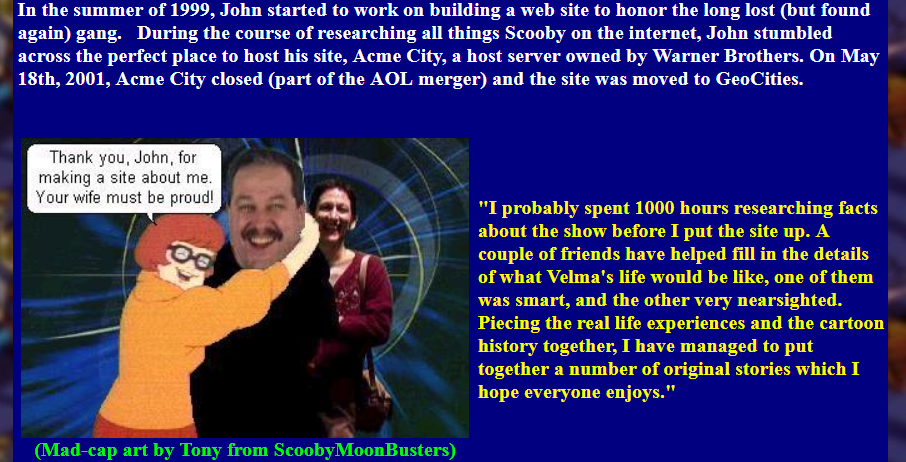
Is there nothing left then to appreciate from the ACMEcity era? Well, there is this little gem. A fanpage for the character Velma Dinkley and the Scooby Doo franchise in general. The site was created in 1999 by a man going by the alias of John Likeglass. It was originally hosted on the ACMEcity servers. When ACMEcity shutdown, John was one of the few people who was able to migrate his page elsewhere. First to Geocities and later to a professional webhosting platform under the URL of velmadinkley.com. While John became a lot less active on his page around 2005, his website and especially his Velma chatbox remains a sort of community center for the Scooby Doo fan community. Likeglass even became the focal point of an investigative Youtube video 2 years ago when people in the Scooby Doo community worried about him being missing. (Spoiler: He's fine. Sometimes people just move on.) His page has even seen some recent updates in 2023 and 2024! Both Velmadinkley.com and Mr. T versus The Matrix are great examples of what a fandom based webhosting service like ACMEcity would have enabled its users to create. We might have seen a lot of more it if only time permitted.