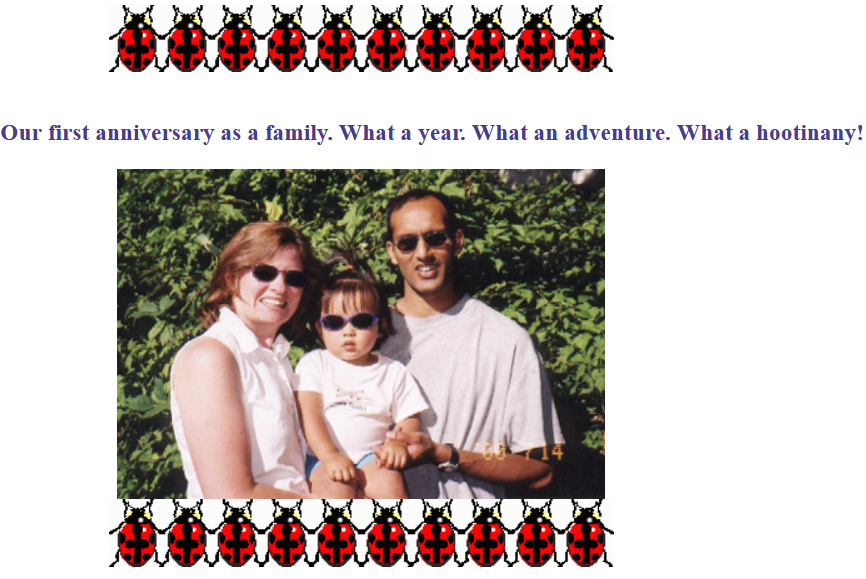
Kris and Andy from Toronto, Canada used to be the inhabitants of adress number 4283 on the Tokyo Courtyard suburb. Their little homepage is titled "Our Daughter from China". It is not surprising then, that this page is largely about their daughter Piper. Born in the province of Hefei in 1999 in China, Piper's name given by her biological parents is Qiu-Ping. At 10 months, she was adopted and moved to the other side of the Pacific Ocean to start a new life. At the time of their writing, Piper had just turned two, meaning the page was last updated in september of 2000. The rest of the page is a cosy slice of life. One photo shows her playing with other adoptive children from Hefei province playgroup. On the bottom of the page there are some links. One link goes to Family Outreach, the adoption agency which Kris and Andy used. Unfortunately, there are no follow-ups to the story of Piper, Andy and Kris. At this point you might be wondering why I am taking the time to feature this cute, yet unremarkable page about a family adopting a girl from China. The thing is, this page is just one of many such pages I have found on Geocities. There are dozens of others like this one or this one, where mostly American and Canadian families tell the story of how they adopted a daughter from China. In the mid 90s adoption from China was a booming business!
Before we get into the online community, a brief explanation for the reason why so many people were suddenly adopting girls from China. In 1979 the Chinese Communist party, fearing overpopulation and food shortages as a result, implemented their now infamous One-Child Policy. Existing cultural attitudes, such as the expectation that a son would take care of his parents at old age, whereas a daughter would marry into another family, created a situation where parents giving born to a first born daughter saw no other option than to abandon their child. If they decided to keep their daughter and give birth to a second child they would face a penalty. This led to child abandonment and in some cases even infanticide. In the mid 80s the One-Child Policy was relaxed somewhat. For example, rural families with a first-born daughter were allowed to have a second child. In spite of these changes the One Child Policy resulted in overcrowded orphanages full of perfectly healthy, young girls that unfortunately did not have a place in Chinese society at that time. Meanwhile in the West, increasing access to contraception, decreases in teen birth rates and reduced stigma surrounding unmarried parenting were just some of the reasons why the amount of domestically adoptable children was rapidly decreasing. In 1992, China legalised international adoption. All of a sudden there was a big and constant supply of very young, usually healthy children available for adoption by white folks. These children did not come from extremely poor, war-torn countries. They did not have any special needs either. They were just the unfortunate victims of a very unfortunate policy and most of all, they were all girls. They were the ideal adoptive children.
Now let's say you were considering to adopt a girl from China in the nineties. What would your journey look like? Most likely you would start by reading one of the many pages such as Kris and Andy's, sharing their experience to give you a taste of what to expect. The internet was full of testimonies, such as this one. The Adoption in China Homepage was popular around 1996. It was managed by Steve and Carol, who adopted two girls from China. Their homepage used to feature photos of the girls, but since they were being linked to from pedo sites (sigh) they had to take them down. Steve and Carol's page is a great resource for first hand experiences on what the adoption process is like. They wrote diaries of their two trips to China, the first in may of 1995 and the second in february of 1996. They are not the most typical adoptive parents as they chose not to adopt infants, but 4 and 5 year old girls, respectively. I particularly found this excerpt to be interesting. Because it shows how unnatural it must have been for Steve, Carol and their daughter Tory on that first morning, when they suddenly became a family:
While getting ready to start the day, Xin Fen decides that toothpaste is to play with, and refuses to put it down. I am forced to exercise my authority for the first time as she begins to test her limits. We experience her first temper tantrum with us as her parents, and she's one very unhappy little girl. It lasts only a short time. She'll get over it.
The reason Steve and Carol's site got a lot of traffic is because it was listed on Families With Children from China (FWCC), which was certainly an online authority for all things China Adoption at the time. If you visited the FWCC page somewhere in 1998 you would see this news item about the recent relaxations of Chinese adoption laws. Among the changes was a lowering of the age from which couples were allowed to adopt from 35 to 30. According to the article, the overcrowding of orphanages had led the Chinese government to relax the law. There was a news page that was updated frequently featuring all the latest you had to know. FWCC also kept a lot of statistics, which could be found here.
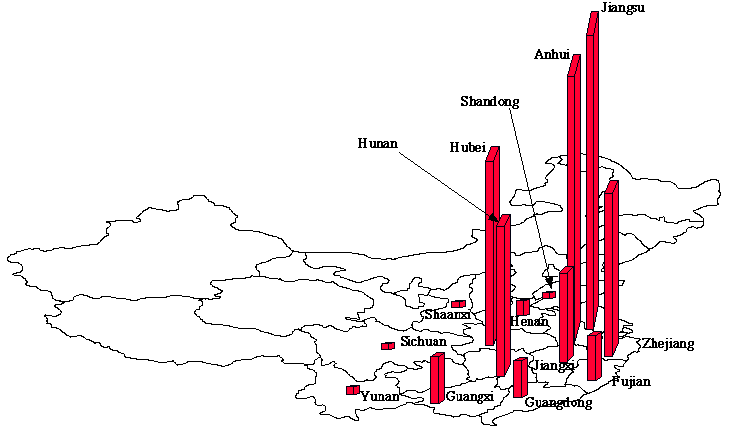
This neat graph shows from which provinces adopted children mostly originated. Notice that Anhui, where Piper, Kris and Andy's daughter, was born, was the province with the second biggest number of adoptions, only outperformed by Jiangsu. Yet another graph on the page will show you how adoptions had been on the rise in 1996 compared to the previous year. Eventually, you would probably end up on the information page for prospective parents. Here you could find out whether you would qualify for adoption under the current rules, as well as a breakdown of the costs. Now, before you would make the decision on whether or not to adopt, you would hopefully have also read this page on the web. Before you decide become an interracial family, it might be a good idea to check if you're not actually a racist!
Once you made the decision adopt a child from China, the logical next thing to do next to do would be finding an adoption agency. Kris and Andy used the Ottawa based Family Outreach International (FOI). The agency was founded in 1995 and has been continuously managed by Yulin Deng throughout its history. A 2003 archived version of their page mentions FOI having assisted in the adoption of 350 children at that point. Judging from all the events going on, such as information meetings for soon-to-be parents and playgroups for young children, FOI made a sincere effort to create a community for families in the Ottawa region. Yulin dilligently maintained a page with trip reports sometimes written by herself. The Adoptive Stories page contains interesting articles written by parents about different topics. I particularly liked this one written by Kathie & Tim on how to let your baby adjust to you.
Perhaps the first sense a baby relies on. newborns can distinguish their mother's breast pads from another mother's, within a few hours of birth. Because breath and body odours come from the food we eat, I made sure to eat as great a variety of Chinese food as I could when we arrived in Beijing, even though I was jetlagged and wanted just to skip dinner and go to bed. I don't wear perfumes or fragranced cosmetics, or use fragranced fabric softeners on my clothing anyway, and I didn't wash my hair the morning of the day we met. I wish that I had taken it one step further and worn the same clothes I had worn to the restaurant the night before. You don't have to look posh at that first meeting.
I found it endearing to read how these soon to be parents were trying everything they could to smoothen the transition process. Inluding eating lots of Chinese food in the days leading up to their first encounter with their daughter. I'm sure it helped a little. It really reminds me of how idealistic and micromanaging my wife and I would get when our eldest son was about to be born.
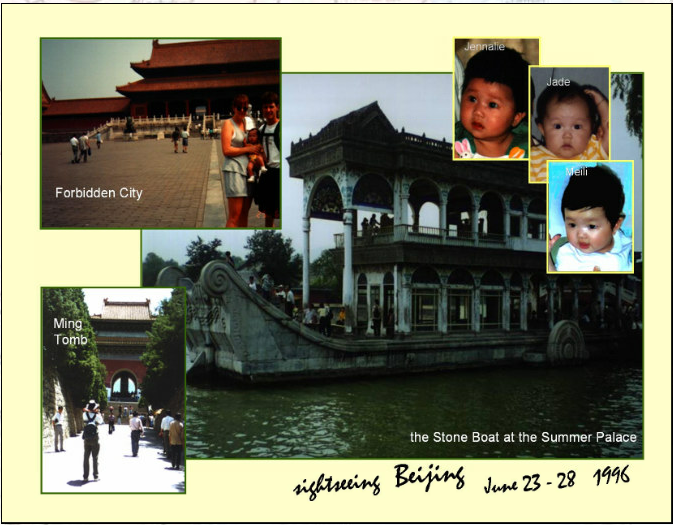
A self-made digital postcard from one of the trips taken to China by Family Outreach International
Later archived copies of the FOI website, showed that the adoption agency expanded their community building efforts. Not just for parents, but also for the kids when they would grow older. Around 2005 a new page was started called Young Authors. It provided a space for kids to write about whatever was on their mind. FOI also published a quarterly newsletter from 1998 to 2008. Most of which can be found and read on the archived page. After 2008, the newsletter stopped being published. I believe this is not coincidental. On a 2007 version of the page, there is a message on the front page warning people about the increasing amount of adoption requests to the China Centre for Adoption Affairs. While demand was still increasing, the amount of annual adoptions had reached its peak in 2005 and would go into a steady decline from there on out. This newspaper article by the South China Morning Post tries to explain what was happening.
China, as has been the case for several years, accounted for the most children adopted in the US. But its total of 1,475 was down by 22 per cent from 2017 – a drop of more than 400 children – and far below a peak of 7,903 in 2005. This represents a drop of 81 per cent in the past 13 years. Suzanne Lawrence, the State Department’s special adviser on children’s issues, said the steady decrease in adoptions from China was linked to an improved Chinese economy and the expansion of domestic adoption there. She also said US adoption agencies were hampered by China’s laws restricting activities by foreign non-governmental organisations.
After 2009 Family Outreach's website was updated more sporadically. A 2011 annual report shows how rapidly the adoption numbers in the Traditional Program were decreasing. The Waiting Children Program still had relatively higher numbers. This was the program for adopting older and special needs children. In 2016, after more than a decade, the website design of FOI changed drastically to a sterile form of its former self. The page mentions both the Traditional and the Waiting Children programs being closed. Waiting times for adoption from China had increased to over 10 years, making continuation of the program impossible. The site contains a 2015 annual report, mentioning Yulin Deng still as the executive director. The report explains that the agency is finalizing adoptions on the Waiting Child program for the remaining 13 families on their waiting list. They expect to wind down activities within the next 2 to 3 years. In total Family Outreach International claims to have assisted in the adoption of more than 1200 children.
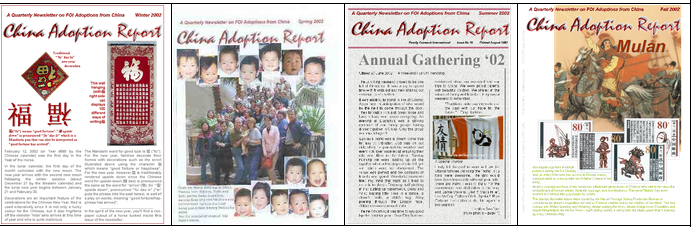
A collection of covers from Family Outreach's newsletter.
The gradual fading out of Family Outreach International's activities can not be seen separately from the official end of China's One Child Policy in 2015. On January 1st 2016, after more than 35 years, China introduced the Two Child policy. Within 5 years this was replaced by a very short lived Three Child policy. In 2021 the Chinese government finally abandoned all restrictions to the amount of children people were allowed to have, restoring reproductive rights to their people. They even actively started encouraging people to have more children. The birth rate has been plummeting in a manner similar to neighbouring countries like Japan and South-Korea. In 2025, the government is offering citizens financial baby bonuses, as well as extended maternity leave for having more children. More controversially they have raised taxes on condoms and birth control pills by 13%.
Adoption from China was very popular from the early nineties on. One of the reasons why it was so popular for Westerners to adopt from China, is because the process was relatively smooth and reliable as there was a constant supply of adoptable children. I mentioned in the beginning of this article that it was a booming business and this was true in the financial sense as well. Orphanages in China would make a lot of money from adoption. There was an unofficial donation fee that adoptive parents would pay to the orphanage off the books, about 3000 dollars in cash, as compensation for raising the child up until then. For the Chinese these were huge, but necessary sums of money as the orphanages were often underfunded. At the same time these big sums of cash led to corruption, such as orphanage directors using the money for personal use. The orphanages had become dependent on adoptions to stay afloat. When the supply of adoptable daughters from China dwindled, the entire adoption supply chain faced an existential threat. Orphanages were competing among each other to receive babies from middle figures, paying them higher prices. You can imagine how this created a perverted impulse for those middle figures to get their hands on more babies. Whether those babies were actually abandoned became of less importance. There are horrific cases known of babies being stolen from the arms of parents of siblings in broad daylight. You can learn more about child trafficking as a result of the $3000 donation system on this page which contains an excerpt from Barbara Demick's 2025 book "Daughters of the Bamboo Grove".
As for the many daughters from China who grew up in their adoptive families, they are now adults, some of them entering their thirties. As is often the case with adopted children, the desire to find their biological parents becomes stronger as they reach adulthood. I found Youtuber Chennabay's channel especially interesting in this regard. Adopted into a Dutch family as a baby, she started the search for her biological parents a few years ago and documented the process. Last year she uploaded this popular video of her going to China and finally being reunited with her biological parents. Her channel shines a light on what it's like to grow up as an adopted child and the struggles you deal with later in life. Adoption is never a first choice for any parent. Often it is a last resort. However, the children themselves had even less of a saying in the matter. Looking back at the One Child Policy era and all the girls that have been taken away from their parents, it all seems pointless. The Chinese government claims that the policy prevented a population increase of roughly 400 million people in China, but some researchers have stated their doubt on whether the One Child Policy had any meaningful effect on the population at all. Especially in the light of the current low birth-rate and steady population decline, one can only conclude that One Child Policy has created not ripple effects, but tidal waves for the Chinese people. A collective trauma that will be felt for decades to come with very little to show for it.
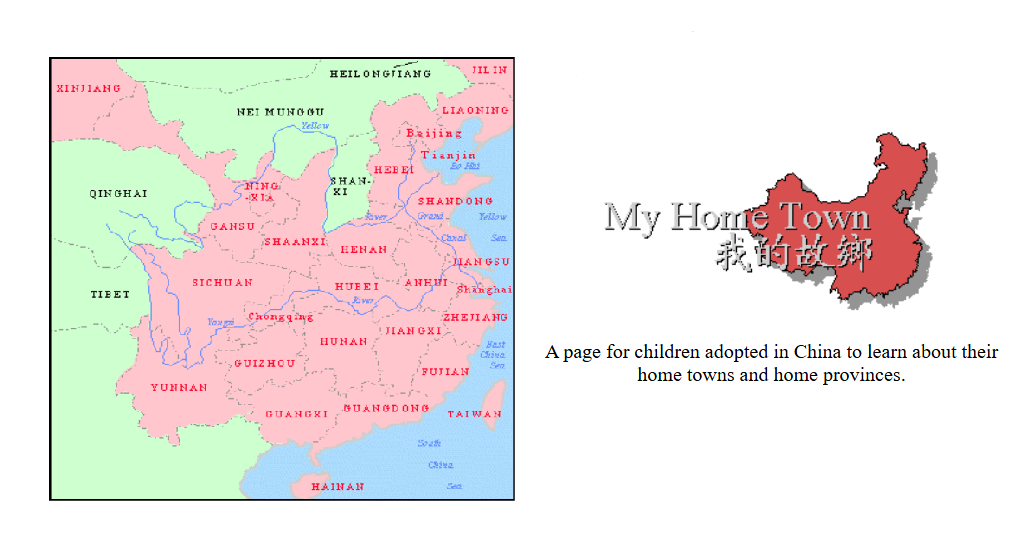
It might be hard to find beauty in all of this, but I do believe that the Western parents who adopted their daughters from China made a sincere effort to make the best of a bad situation. The online adoption community to me is evidence of that. I have only mentioned a few examples, but if you look around there are countless pages where people used the power of the internet to connect, share and learn. I haven't even been able to squeeze in this lovely website called "My Home Town" where adoptive children could learn about their city or province of origin. The site had a super interesting page about the origins of surnames for abandoned children. As child abandonment was illegal, parents could not write down their child's surname. Orphanages thus had to get creative in deciding names for their children. The city of Chengdu, for example, had the practice of naming their children after the animal on the Chinese zodiac calendar in the year they were brought in. Or this page selling dolls with different skin colors and ethnicities so that children had a doll they could identify with.
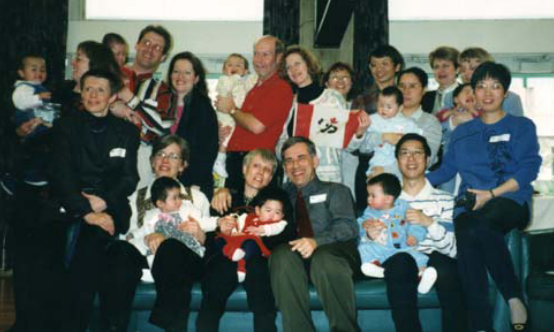
Through the power of the internet, people created a decentralized community where everyone provided information and contributed a small piece of the puzzle. It was one of the first online communities of its kind and a prime example of what the internet can be when it is used right.